
It is college football at its finest. A televised game during prime time between known rivals. Just before the scheduled kickoff at 7:30 pm, the stadium goes dark. A short circuit in the busway created a power surge that caused a transformer to fail, delaying the start of the game almost two hours.
When the game started at 9:15 pm, only field lights were available. The generators the staff moved to the stadium only had sufficient power to operate the lights. The game started with no scoreboard, time clock, or team communications. Full power was not restored until the start of the second half.
Not only was the delay frustrating for players, coaches, and officials, it impacted vendors and fans. Without power, payment for concessions and merchandise became cash-only. Wireless access points were down as well as any automated systems. Security personnel suddenly lost control of access systems and security camera feeds. Fan safety became an in-person job.
Situations like this make resilience and centralized network management increasingly important. PoE private networks can help by delivering power and data to compatible devices over the same Ethernet infrastructure while giving network teams greater control over how those devices are connected, powered, and managed.
Many stadiums and public venues create private networks to ensure consistent performance and reduce security risks. While a private network may have a link to an external network, all power and connectivity is controlled by the venue or stadium, making their staff responsible for restoring power and bringing services online. Deploying a power-over-Ethernet (PoE) private network can mitigate the risk of power outages that cause game delays and impact fan experience.
What is a Private Network?
A private network is an organization-controlled network designed to connect authorized users, systems, and devices rather than provide unrestricted public access.
Suppose a small business owner owns the building that houses the business. Power is delivered to an entry point, usually an electrical panel or breaker box, and distributed throughout the building. The wiring, outlets, and switches are part of the infrastructure that makes up the private network. Once power enters the building, the owners are responsible for power outages that impact the building.
The same concept applies to a computer network. Internet services are delivered to an access point, usually a gateway or router. From that point, the connection is distributed to other devices such as security systems, computers, and printers. Once the connection reaches the gateway, the owner is responsible for maintaining connectivity to all devices.
The larger and more complex the facility becomes, the more important network visibility, segmentation, and centralized management become.
For stadium managers, the responsibilities are the same, only more complex. They must ensure power and data reach endpoints such as field lights, payment terminals, scoreboards, and time clocks. Network administrators manage security cameras, access control, and on-field communications. They may create sub-networks to isolate guest activity from operations. Troubleshooting and isolating a failure, such as a faulty circuit, can take hours, given the size and number of devices on a stadium’s private network.
What are PoE Private Networks?
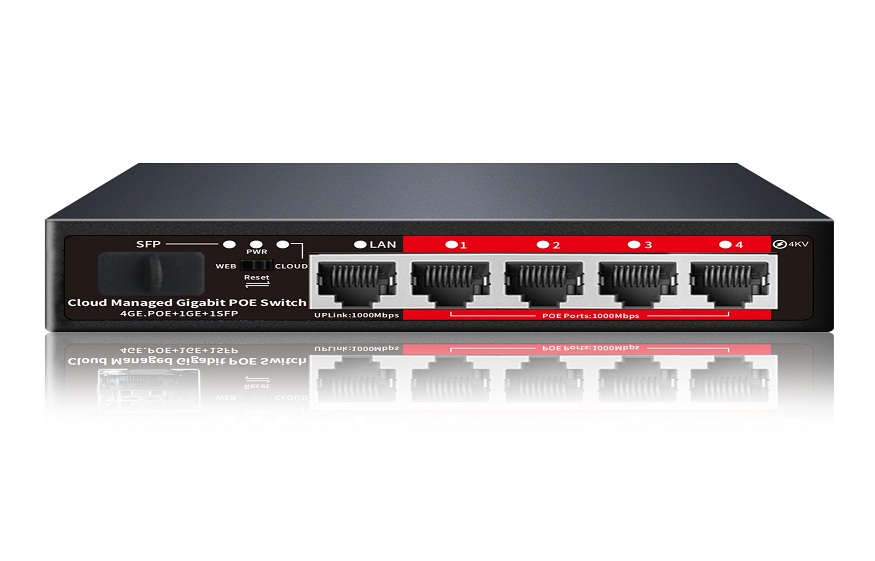
A PoE private network incorporates PoE technology into its infrastructure. With PoE, a single Ethernet cable can carry power and data, eliminating the need for a separate power source. Network technicians can run cable in hard to reach places, allowing devices such as cameras and wireless access points to be placed for maximum coverage.
PoE can operate low-powered cameras and IP phones, requiring no more than 15 watts of electricity or high-powered devices needing up to 90 watts of power. The technology can meet today’s power demands and support data transmission needs of gigabytes per second. When connected to an uninterruptible power supply (UPS), PoE power sources can keep devices running even during a power failure.
Private vs. PoE Private Networks
Suppose the stadium that suffered the power outage had PoE technology as part of its infrastructure. The equipment room would have held computers and servers as well as routers, gateways, PoE switches, and video recorders with backup power supplies. Depending on the stadium size, equipment closets would also have held PoE switches to ensure consistent operation throughout the arena when connected to a UPS. The PoE endpoints or edge devices such as cameras, lights, and payment terminals would have connected to an equipment closet or room.
When the transformer failed, PoE switches would have received power from a UPS. The switch, acting as the power source for connected devices, would have continued to send electricity to lights, security cameras, and access panels. The game could have started at 7:30, as scheduled, and the stadium security could have remained intact. Wireless access points would have ensured in-stadium communications and an uplink would facilitate online payments.
Although a stadium scoreboard requires more power than a PoE connection can deliver, the technology can support video screens, often used on concourses, to display basic information and operate as a time clock until power is fully restored. With a PoE private network, games would start on time with minimal interruptions and little impact to the fan experience.
PoE Private Networks in Multi-Tenant Buildings and Shared Spaces
Many of the same benefits apply to office towers, mixed-use properties, and other shared buildings.
Like stadiums, multi-tenant buildings require reliable access to power and data. Like stadiums, they need facility-wide private networks that can be divided to provide users with separate connectivity to prevent cross-traffic interference. Like stadiums, they should use PoE private networks to ensure performance during a power outage.
For example, office buildings have a facility-wide private network that controls heating, cooling, lights, security cameras, and access controls. The building’s backbone is then divided into securely segregated private networks for each occupant. Placing PoE switches on each floor allows sensors, lights, and WiFi access points to operate continuously when connected to a UPS and reduces the risk of cascading failures if one floor loses power or connectivity.
Versa’s PoE Switches
Using a PoE switch such as Versa Technology’s VX-GPU2626 24-port switch can provide the resources needed to manage an office floor. With 24 10/10/100TX UPOE ports and a total of 2000W, the managed switch delivers power and data while reducing power consumption and total cost of ownership. Following the Institute of Electrical and Electronics Engineers (IEEE) standard for energy efficiency, the switch idles devices and disables transceiver circuitry without losing connectivity when devices are not in use.
Layer 2 and 3 security features keep data secure. The switch offers IPv4 and IPv6 static routing as well as Layer 2 capabilities such as spanning tree and internet group management protocols for v1, v2, v3 snooping to protect against unauthorized access. A built-in device management system offers topology, floor, and map views for more efficient placement and monitoring.
Read More : How to Choose the Best i7 Laptop for Your Needs?
Versa Technology’s range of PoE switches includes industrial switches that can withstand environmental extremes. Other switches allow remote device restarts and offer enhanced diagnostics, simplifying network management. Whether you operate a stadium, entertainment venue, or a multi-tenant building, building a PoE private network can minimize the risk of a game delay.